

A Kiwi soldier missing in action in Ukraine is presumed to have been killed on his first day on the frontline.
A year has passed since Jeremy Braggins, aged in his early 50s, was listed as missing in action, presumed killed, in intense fighting in the Donetsk Oblast region of eastern Ukraine.
Braggins was a volunteer member of the Ukraine International Legion, going to the frontlines as a soldier and medic in mid-May 2025.
His likely death was revealed five months later after several Ukrainian memorial websites that honour those killed in fighting posted about Braggins, with one saying, “Our beloved New Zealand brother who had been serving in Ukraine as a volunteer succumbed on the battlefield” and wishing him “honour, glory and gratitude”.
A photo of him in uniform, along with his military call sign “Badger”, has circulated on a Telegram channel where “Russian patriots” celebrate the reported deaths of foreign fighters.
A year on, one of his former squad mates – a former soldier in the US Army – has talked to the Herald about the bond he built with Braggins during two months of training in Ukraine and given more background about the fateful mission the Kiwi was sent on.

American soldier Addison Jureidini (inset bottom) has recalled his friendship with Kiwi soldier and medic Jeremy Braggins (inset top) a year since the New Zealander was listed as missing in action in Ukraine. New Zealand Herald composite photo
“In camp, his bed was right next to mine,” Addison Jureidini said from his current base in Puerto Rico.
“We talked every day.”
Conversations covered family, including Braggins talking about his parents, who had retired and now lived in Europe, and his previous service in the New Zealand Army Reserve.
Jureidini said Braggins was one of two New Zealanders he met during his time with the Ukraine International Legion.
Braggins, a trained emergency medic who had previously worked in ambulances for a private hospital in South Africa and Jureidini were among a minority group of English-speakers in their unit who hung out together.
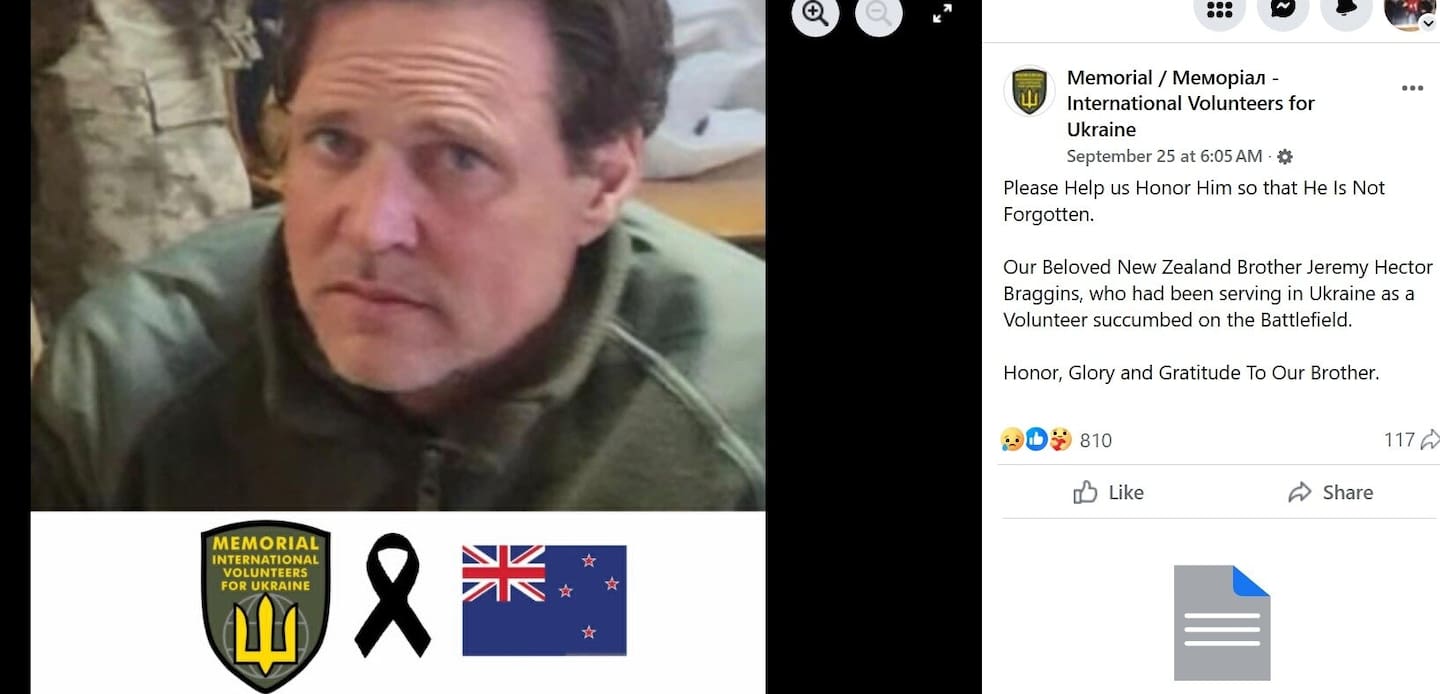
A tribute to Kiwi Jeremy Braggins was posted by a Ukraine war memorial site last September.
That included trips to Ukraine capital Kyiv when they were given weekend leave.
As well as completing basic military training together at a Ukrainian base, the pair were among unit members sent to an advanced medical training course.
Braggins aced the course.
“He was good,” Jureidini said. “He passed it really easily.”
Jureidini failed the course. He completed a further advanced infantry course before rejoining Braggins at the unit, which was then sent off to fight for Ukraine.
Combat orders: ‘Expect landmines, expect drones, don’t expect air cover’
Ukraine International Legion reinforcements featuring Braggins and Jureidini travelled to Kramatorsk in the Donetsk Oblast area via train and bus.
“The train was really cramped,” Jureidini said.
Their unit initially set up in an abandoned house for several hours before being ordered to relocate because of an air attack alert.
Later, the group was told by their sergeant, who had previously served in the Croatian Army, that they were going to attack a nearby village.
The first briefing talked about the location having about 10 buildings in it.

Kiwi soldier and military medic Jeremy Braggins (back row, third right) with his Ukraine International Legion comrades including American Addison Jureidini (back row, second right) before being deployed to the frontline.
The next day, another briefing had upgraded the village to featuring about 30 buildings, with Jureidini recalling the soldiers were told an “unknown number of Russian troops” were also based there.
“They showed us the map. They said, ‘You’re going to cross this open field, expect landmines, expect drones, don’t expect air cover’. They said expect elevations on two sides [troops had to move through].”
The legion members were then told: “Whoever wants to go on this assault tomorrow, say plus. If you don’t want to go, say minus and you go home.”
Jureidini said he believed the foreign soldiers were given the chance to opt out as Ukrainian commanders didn’t “want to be seen as coercing you because I guess they expect high casualties”.
Three people said “minus” – an Italian, another squad sergeant and Jureidini – and would be sent back to a training camp.
It was there that Jureidini was later given the news that “all these people are dead”.
“I said, ‘What happened to Badger?’ They said he’s dead. I felt bad. I liked that guy; he was a nice guy.”
It was their first experience of combat on Ukraine’s frontline.

A "We Stand with Ukraine" sign remains in place outside of a residence in New York City. Photo / Getty Images
With most of his comrades either dead or listed as MIA, Jureidini was told he would be picked up by another Ukraine International Legion unit.
It was an opportunity he declined, eventually leaving the war-torn nation.
Jureidini said his heart went out to Braggins’ family.
Ukrainian soldiers and members of the Ukraine International Legion are legally listed as MIA until the return of a body, body parts or other DNA proof.
Braggins’ father, Ian, has previously told the Herald family can’t accept he is dead until they have a body.
His father said he understood why people have said his son was dead.
But the nature of the solemn-looking photo of Jeremy circulating online, and the fact the family saw it first on the Telegram channel, allows him to hold out hope his son survived.
His son hated having his photo taken, Braggins said. He wonders if Jeremy could be a prisoner of war and that the photo was taken by Russians.

Jeremy Braggins' family are not giving up hope he is still alive, despite being listed as missing in action since May 2025 and claims from Russia that he was killed.
They have been in contact with the Red Cross, which is looking into the cases of more than 30,000 people listed as missing in the conflict.
Ian Braggins told the Herald last week his family continued to seek answers.
“It’s coming up to 12 months and we are in reality no further down the line to finding out what happened and the results of that action.”
Braggins is one of at least eight New Zealanders believed to have died in fighting in Ukraine.
Many more have been left with life-changing injuries.
How Russian forces got identities of Braggins and his comrades
Jureidini went by the military callsign “Grant”, after Ulysses S. Grant, the commanding general who led the Union Army to victory in the American Civil War, and also America’s 18th President.
Unlike many other members or ex-members of the Ukraine International Legion, he said he was happy for his identity to be published.
Many veterans want their identities kept secret, so they and their families are not targeted by Russian “patriots”.
Increasingly, blackmail attempts have been made targeting families of foreign fighters, personal details have been revealed on Russian social media sites, and social media accounts of fighters and families have been bombarded with abuse.
Flowers at the Eternal Flame in Kyiv this month mark the Day of Remembrance and Victory over Nazism in World War II, which was observed despite ongoing conflict after Russia’s full-scale invasion. Photo / Getty Images
Flowers at the Eternal Flame in Kyiv this month mark the Day of Remembrance and Victory over Nazism in World War II, which was observed despite ongoing conflict after Russia’s full-scale invasion. Photo / Getty Images
Jureidini said one of the items found by Russian troops on a dead soldier, who was one of Braggins’ comrades, was a cellphone that included the full names and call signs of every member of the unit.
“The Russians have my name and everyone in the unit,” he said.
Those names, including Braggins’ and a photo of the Kiwi, have all been published on a social media forum featuring pro-Russian war rhetoric.
Neil Reid is a Napier-based senior reporter who covers general news, features and sport. He joined the Herald in 2014 and has 34 years of newsroom experience.
Take your Radio, Podcasts and Music with you
Get the iHeart App

Get more of the radio, music and podcasts you love with the FREE iHeart app. Scan the QR code to download now.

Download from the app stores


Stream unlimited music, thousands of radio stations and podcasts all in one app. iHeart is easy to use and all FREE


