
Follow
the podcast on

Nine days, 22 hours, and 32 minutes.
That’s how long the Artemis II crew has been away and as we speak this morning, they’re entering the final, critical hours of their mission. All going well, by the time Jason Pine welcomes you to Weekend Sport after the midday news, the capsule will have splashed down in the Pacific Ocean. The four people who’ve travelled further from Earth than any other human beings ever will be fished out and whisked off, home to NASA in time for supper.
As someone who wasn’t here for the Apollo missions, Artemis II represents the most exciting crewed space mission of my life. There have been other big moments: rescue missions to the International Space Station, perilous repair jobs that have needed specialist, highwire space walks. But Artemis is the first crewed mission to leave low Earth orbit since Apollo 17, 54 years ago.
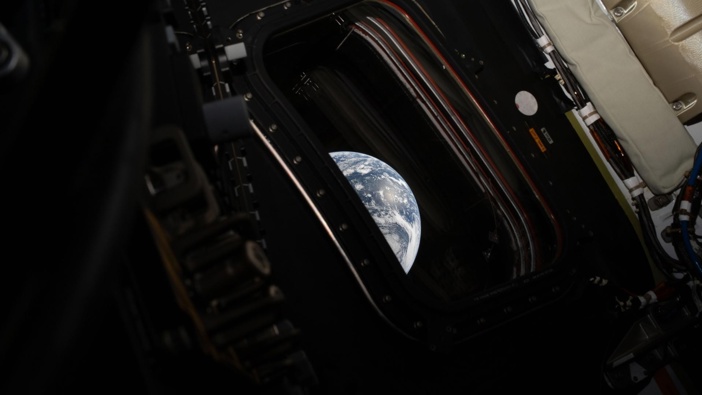
For me, that’s what’s significant. When many of us think of the view of Earth from space, we think of something from the movies. We think of Earthrise, a marble hanging in space. I have that photograph hanging on our wall at home. It’s seductive to pause for a moment and think of our planet in the context of the big black.
But that’s not what most astronauts see. I’ve done the maths. Well, no. I’ve looked up the geometry. The International Space Station orbits the Earth at a distance of about 400km. About 10 or 12 times the cruising altitude of a passenger jet. That’s high, sure, but if you look out the window at that altitude, the Earth is right in front of you, and rather than a sphere floating in space, it looks like a giant curved surface.
You’ve got to go more than twice as far to see the whole Earth as a sphere. At 1000km, it still fills a huge part of your visual field, but you have to scan your eyes from left to right to take it all in. At 10,000km you can see the whole Earth, the whole sphere, the whole she-bang without moving your eyes. I reckon this is when the most significant shift must take place. It’s a view no one’s had in more than fifty years.
Artemis II travelled 400,000km from Earth. What are you doing? Can you extend your arm out? Reach out and put your thumb up in the air. In the context of your whole visual field, look how small it is. That’s how big Earth would have appeared from that distance.
I sat at the dinner table with our nine-year-old this week as the Artemis crew prepared for their 40 minutes of unbreakable solitude, the little window of uncontactable-ness as they passed by the far side of the moon. He had so many questions. He was so full of wonder. And almost every time he started with “but how do they...” my answer was “Well... maths.”
I can only imagine what the Apollo missions must have been like to follow from Earth. It must have been extraordinary. The difference this time around is the technology. The photos sent from the crew are beamed back to Earth and almost immediately shared by NASA. The interactive tools online let you plot capsule’s route.
You don’t have to be a nine-year old to feel the wonder. You don’t have to be 400,000km from home to have a little sense of what those crew members must feel when they look back at our planet as a distant sphere in the epic vastness of space.
It must make of our quibbles and disputes seem so petty and trivial. Simultaneously humbling and profound.
Take your Radio, Podcasts and Music with you
Get the iHeart App

Get more of the radio, music and podcasts you love with the FREE iHeart app. Scan the QR code to download now.

Download from the app stores


Stream unlimited music, thousands of radio stations and podcasts all in one app. iHeart is easy to use and all FREE


