

The crew has flown more than 400,000 kilometres from Earth on the astronauts’ historic voyage around the far side of the moon.
New images have been released from the historic journey taken by Nasa’s Artemis II crew, who have ventured farther from Earth than any humans before.
The photos were released hours after the crew of Nasa’s Artemis II mission broke a record, zooming more than 248,655 miles (400,171km) from Earth in a voyage around the far side of the moon.
The distance record, set just before 2pm Eastern Standard Time on Monday (6am Tuesday NZT), surpasses a milestone set by Apollo 13 in 1970. During that mission, an oxygen tank explosion prompted the astronauts to ditch their landing plans and slingshot themselves around the moon before arriving safely home.
“On April 15, three explorers set the record for the farthest distance humans have ever travelled from our home planet,” Kelsey Young, a science officer for Artemis II, told the crew from Mission Control. “Today, for all humanity, you’re pushing beyond that frontier.”

The heavily cratered terrain of the eastern edge of the South Pole-Aitken basin is seen with the shadowed terminator – the boundary between lunar day and night – at the top of the image. The South Pole-Aitken basin is the largest and oldest basin on the moon, providing a glimpse into an ancient geologic history built up over billions of years. Photo / Nasa
The spacecraft was closest to the moon - and farthest from home - about 7pm EST on Monday, when Artemis II set yet another record for human travellers: 252,760 miles from Earth.
Artemis II commander Reid Wiseman, pilot Victor Glover, and mission specialists Christina Koch and Jeremy Hansen awoke Monday morning to a special message recorded by Apollo 13 commander Jim Lovell before his death last year.

A view of a backlit Earth as seen through the Orion spacecraft’s window, photographed by Reid Wiseman, commander of Artemis II, on April 2, 2026, after completing the translunar injection burn. Photo / Nasa
“Welcome to my old neighbourhood!” Lovell said. “It’s a historic day, and I know how busy you’ll be. But don’t forget to enjoy the view.”
Monday’s milestone marks the start of Artemis II’s crucial lunar observation period, when the crew will document a celestial landscape that no human has seen before.
The Apollo missions were orchestrated so astronauts would arrive at the moon when its near side was facing the sun - giving them plenty of light for landings. But Artemis II’s lunar flyby will occur when the far side is illuminated, giving the crew a glimpse of craters, mountains and other features that were too dark or difficult to see during the Apollo era.
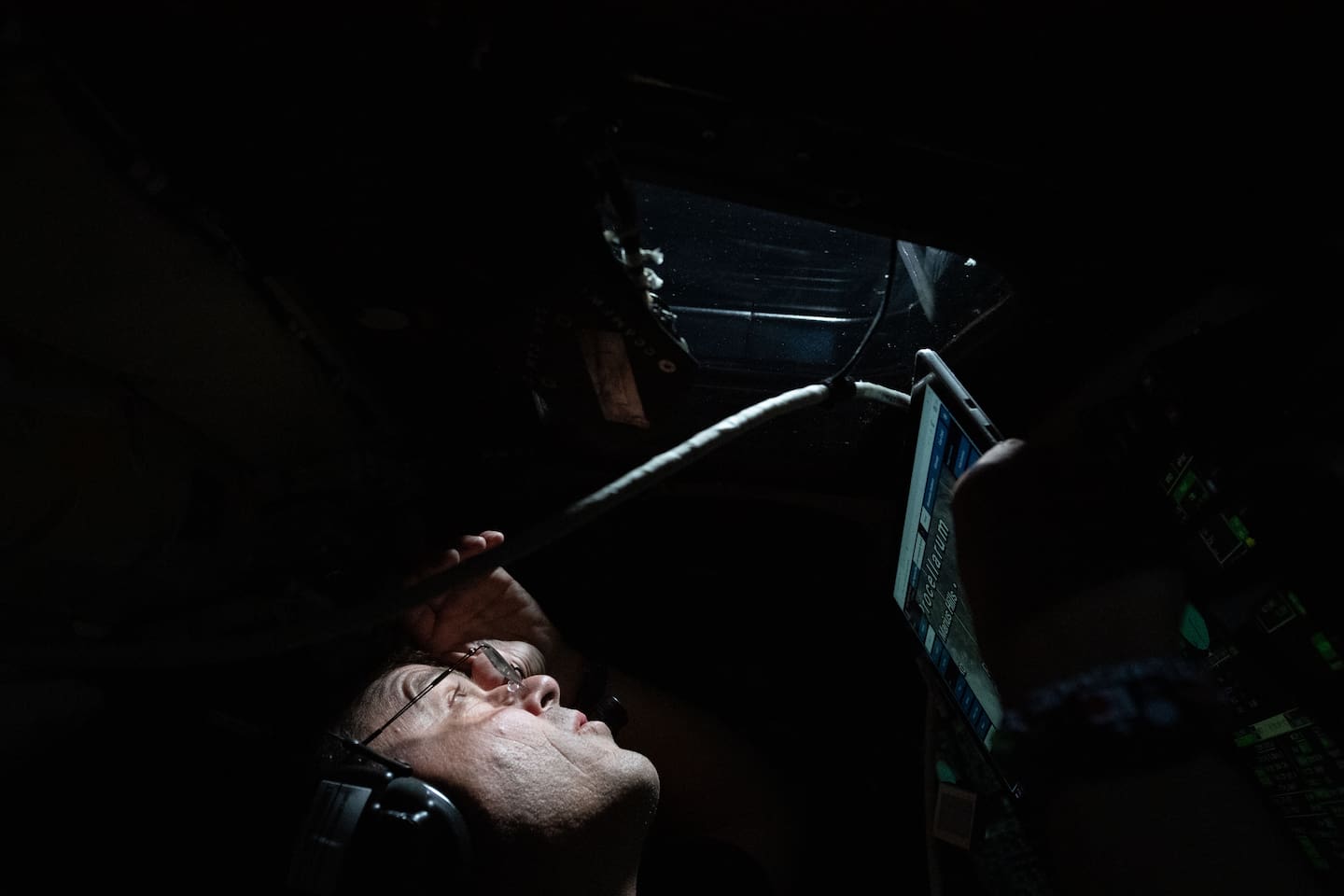
Commander Reid Wiseman peers out the window of the Orion spacecraft as his first lunar observation period of the day begins on April 6. Photo / Nasa

Artemis II mission specialist Christina Koch looking back at Earth through the window of the Orion spacecraft on April 2, 2026. Photo / Nasa
‘It is blowing my mind’
Nasa lunar scientist Sarah Noble said the moon’s ancient landscape - untouched by organisms, rainfall, plate tectonics and the other forces that constantly reshape rocks on Earth - makes it an ideal place to study the processes that shaped the early solar system.
“On the moon we have an entire record that goes back 4.5 billion years,” she said. “If we really want to learn about what was happening in that period, the moon is the only place we can go.”
“It is blowing my mind what you can see with the naked eye on the moon right now,” Wiseman told Mission Control on Monday. “It is just unbelievable.”
The astronauts have already begun identifying new lunar features. Shortly after breaking the Apollo 13 distance record, Hansen requested that a previously unknown crater be dubbed Integrity, after the crew’s name for its Orion capsule.

Earth draws closer to passing behind the moon in this image captured by the Artemis II crew during their lunar flyby, about six minutes before Earthset. Earth is in a crescent phase, with sunlight coming from the right. The dark portion of Earth is experiencing nighttime. On Earth’s day side, swirling clouds are visible over muted blue in the Oceania region. Photo / Nasa
A bright spot on the border between the moon’s near side and far side, Hansen said, should be named Carroll, after Wiseman’s spouse who died of cancer in 2020.
For a moment, the communications line went silent, as the four astronauts aboard Integrity hugged.
About 6.45pm, the crew watched “Earthset”, when our home planet slid beneath the moon’s horizon, cutting off communications with Mission Control.
About 40 minutes later, the astronauts witnessed “Earthrise”, seeing a view similar to what Lovell and his crewmates witnessed during the Apollo 8 mission in 1968.
Speaking to Mission Control on Monday, Koch said she had that photograph hanging in her room as a child: the bleak, grey lunar landscape in the foreground. The black void of space as a backdrop. And at its centre, Earth’s blue and white emerging from shadow - gleaming like a beacon in the endless dark.
Take your Radio, Podcasts and Music with you
Get the iHeart App

Get more of the radio, music and podcasts you love with the FREE iHeart app. Scan the QR code to download now.

Download from the app stores


Stream unlimited music, thousands of radio stations and podcasts all in one app. iHeart is easy to use and all FREE