
CONTENT WARNING: This article contains descriptions of psychological, physical and sexual violence, as well as references to suicide. Helplines can be found at the bottom of the page.
A woman who complained to police about being stalked by her ex-husband only discovered Corrections had allowed him to travel near her hometown when she found a threatening message stashed in her letterbox.
The hand-delivered envelope contained magazine cutouts of words such as “murder”, “kill” and “nightmare” along with photos of spades in dirt.
“At first I was like, ‘What is this? Is this mail that I’ve missed?’ I sort of looked at it, then I saw the words and my hands started shaking,” said Emma, whose name has been changed to protect her safety.
Corrections has apologised to Emma after failing to notify her about her ex’s plan to travel in the area. He was sentenced to prison for breach of a protection order and abuse of a child.
Emma wrote in a letter to government ministers and advocacy groups that she shouldn’t have found out her ex had been granted permission to travel for her district “after threatening material appears in my letter box”.
Emma was in a relationship with her ex for several years, and said it was marred by abuse from early on. She told the Herald she vividly remembers the first time he physically attacked her.
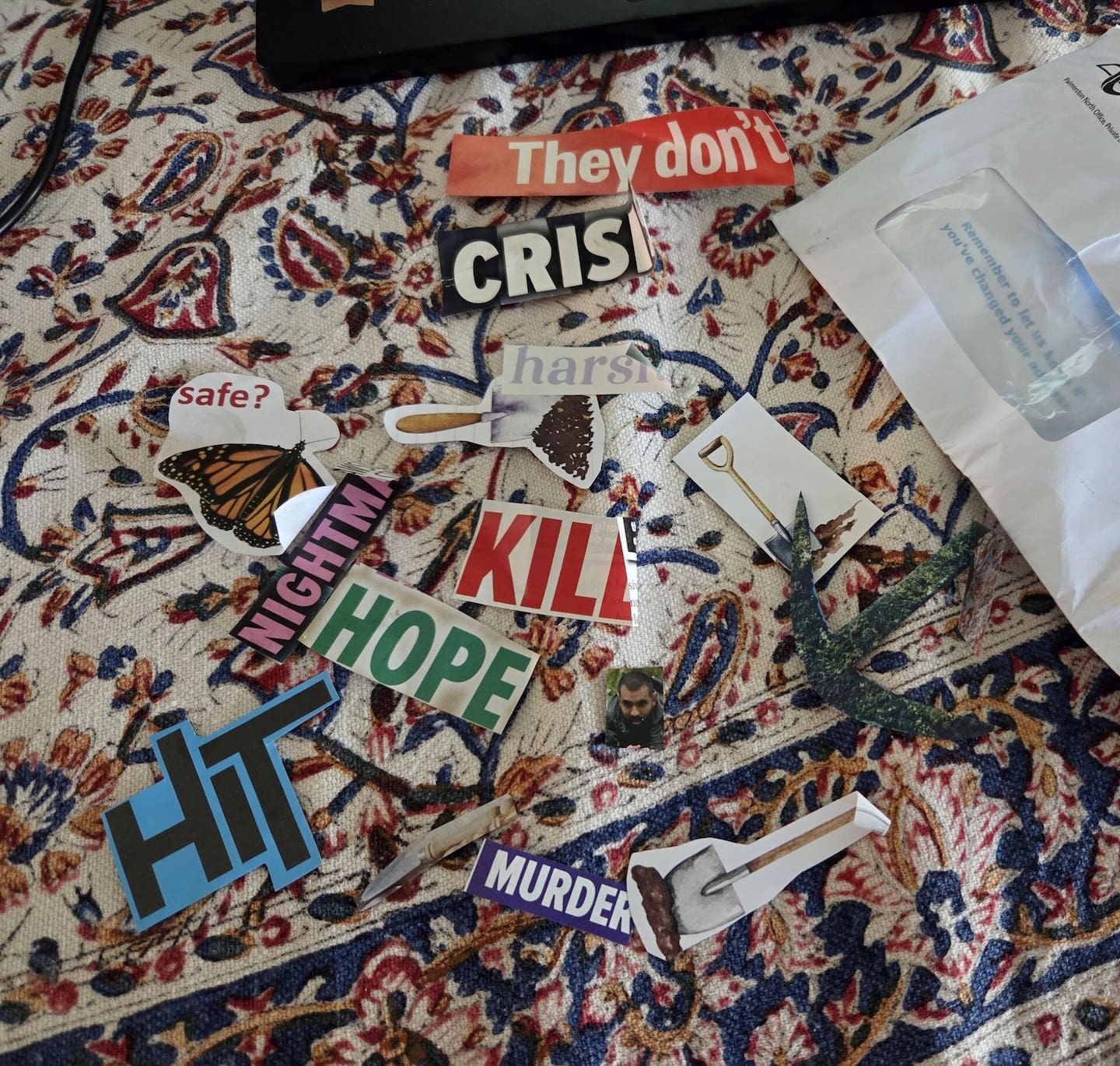
An envelope containing threatening magazine cutouts was left in Emma's letterbox.
“I don’t think I’ve lost any sight of that memory. It has really stuck with me,” she said. “I guess it’s probably the ... basis of my fear of him because I know exactly how far he can go and how strong he is.”
The pair were having an argument and he would not let her leave, she said.
Eventually she fled outside and hid in a shed, hoping he would go to bed or leave the house.
After 20 minutes in hiding, Emma ventured back inside, only to discover her partner was hiding behind the back door.
“He pinned me up by my neck, and he’s choking me, and as I’m struggling to breathe I can feel the constriction against my Adam’s apple and I think I’m going to die,” she said. “He’s like, ‘If you ever do that to me again, I’m going to kill you.’”
While much of the abuse after that was emotional or psychological, Emma said there were still instances of physical attacks to remind her of the threat he posed to her safety.
One such incident happened when she was holding her week-old baby at home, she said.
Emma said they had argued about finances, and her partner, who was holding a freshly brewed takeaway coffee, threw the drink over Emma and the newborn.
“In these moments, there are little things that stick out. You just don’t forget the look of the coffee streaming down the kitchen window, or the fact that you’re holding this just over a week-old baby and ... you’ve had boiling hot coffee thrown at you.”
Thankfully, the baby was swaddled at the time and Emma was able to shield the child from the burning hot liquid, but said she suffered some “pretty horrific burns” herself.
Over the course of the relationship, Emma said, her partner would pressure and control her, questioning her when she spoke to men, pushing her to quit breastfeeding and switch to bottle feeding, and coercing her into postpartum sex, saying it was her “biblical duty”.
“Over time, I learned not to look up when out in public together, in case I was accused of having eyes for someone else. To this day, I remain acutely aware of how I look at or talk to men,” she said.
She also alleged he sexually abused her, which she often endured in silence to avoid waking children.
Stalking, surveillance followed break up
Things did not improve after the pair broke up. He would drive past or sit across the road from her house, sending messages asking about who was visiting her and why, she said.
Her ex would also show up at places Emma went, like the supermarket or park, and appeared to be tracking her movements.
“Once he messaged asking if I ‘really needed that second coffee today’, revealing he knew I had visited a coffee cart earlier and returned for another.”
In April last year, he appeared in a central North Island court for sentencing on multiple charges of breaching a protection order and assault on a child.
Sentencing notes showed he had broken into Emma’s house about 2am one day, appearing in her bedroom as she slept next to a child.
“I just heard my name being called and I woke up and he was there with a backpack on and a hoodie on,” she told the Herald. “I kind of froze, I didn’t know what to do.
“I had concerns about what he had on him or what his frame of mind was in that moment.”
She described that incident as the most “terrifying hour of my relationship with him” as she tried to convince him to leave while avoiding waking up the child. He eventually did, but Emma said she did not sleep for the rest of the night.
The sentencing notes also referred to an incident where the man had punished a child for a tantrum by holding their doll over an open flame until it turned black.
A Family Court judge had commented once that the doll was symbolic of Emma, who had gifted it to the child not long before, she said.
He was eventually sentenced to 22 months in prison, and after his sentence moved to a town more than five hours away from Emma.
But even that distance was not enough after she found a threatening envelope wedged between other pieces of mail in her letterbox.
“I don’t think I slept properly for 10 days,” she said, adding that she has increased home security and adopted a police dog that hadn’t made the cut to join the force.
“I don’t want to be one of those statistics,” she said.
Corrections ‘sincerely apologises’ after failing to notify victim twice
The man was allowed to travel to the area twice because he was given temporary approval to enter the “exclusion zone” while supervised by a third party to collect some personal belongings, Corrections told the Herald.
In cases such as these, Corrections arranged for registered victims to be notified, but this did not happen in this case, spokeswoman Victoria Burgers said.
“On these occasions, a staff member did not follow the correct process, including sign-off and victim notification on both occasions. We acknowledge how important it is for victims to be informed if an offender will be temporarily allowed to enter an exclusion zone and sincerely apologise for not notifying the victim in this case.
“It is important to Corrections that our actions don’t cause further distress to victims, and we will be issuing a reminder to staff about the importance of always following victim notification processes. We will also reach out to the victim and apologise for this oversight.”
Emma said she was disappointed and that it was “not good enough” that the mistake had happened.
Police confirmed they’d received a report of an envelope containing newspaper clippings left in a letterbox.
“While no evidence was located to confirm who placed the envelope there, police are currently reviewing the matter and speaking to relevant parties,” Inspector Phil Ward said.
Emma said she was told the envelope had since been destroyed prematurely by police.
Police said it was photographed then disposed of because it was deemed to have little further evidential value, but Emma said it was supposed to be sent away for fingerprint analysis.
Coercive control can drive victims to suicide
Family violence educator Debbs Murray said the lethal risk attached to coercive control needed to be recognised. It included acts of non-physical violence that created a risk of suicide, homicide-suicide, and familicide.
“This isn’t myth, this is a reality in Aotearoa New Zealand, and every single homicide and suicide is preventable with the right tools and knowledge,” said Murray, who founded Eclipse Family Violence Services.
Often abusers would use the courts to continue to hold levels of control over victims, for example through custody battles.
“This can continue years after a primary victim has escaped abuse.”
Coercive and controlling behaviour was clearly defined in the Family Violence Act, but there was no legislation criminalising coercive control, Murray said.
“Intentionally and deliberately taking away someone’s identity, autonomy, and agency of self, until they live in fear of even breathing too loud – this is called entrapment, and it is debilitating."
She said victims were not hopeless and helpless, but many reached a point where they had “nothing left in the tank to continue the fight”, which could at times drive people to suicide, “which is why it is so important that we recognise suicidal ideation and suicide as a very real consequence of family violence, so no more voices are lost.”
FAMILY VIOLENCE
How to get help:
If you're in danger now:
• Phone the police on 111 or ask neighbours or friends to ring for you.
• Run outside and head for where there are other people. Scream for help so your neighbours can hear you.
• Take the children with you. Don't stop to get anything else.
• If you are being abused, remember it's not your fault. Violence is never okay.
Where to go for help or more information:
• Women's Refuge: Crisis line - 0800 REFUGE or 0800 733 843 (available 24/7)
• Shine: Helpline - 0508 744 633 (available 24/7)
• It's Not Ok: Family violence information line - 0800 456 450
• Shakti: Specialist services for African, Asian and Middle Eastern women and children.
• Crisis line - 0800 742 584 (available 24/7)
• Ministry of Justice: For information on family violence
• Te Kupenga Whakaoti Mahi Patunga: National Network of Family Violence Services
• White Ribbon: Aiming to eliminate men's violence towards women.
How to hide your visit:
If you are reading this information on the Herald website and you're worried that someone using the same computer will find out what you've been looking at, you can follow the steps at the link here to hide your visit. Each of the websites above also has a section that outlines this process.
SEXUAL HARM
Where to get help:
If it's an emergency and you feel that you or someone else is at risk, call 111.
If you've ever experienced sexual assault or abuse and need to talk to someone, contact Safe to Talk confidentially, any time 24/7:
• Call 0800 044 334
• Text 4334
• Email [email protected]
• For more info or to web chat visit safetotalk.nz
Alternatively contact your local police station - click here for a list.
If you have been sexually assaulted, remember it's not your fault.
MALE SEXUAL ABUSE SURVIVORS
Where to get help:
If it's an emergency and you feel that you or someone else is at risk, call 111.
• If you've ever experienced sexual assault or abuse and need to talk to someone call the confidential crisis helpline Safe to Talk on 0800 044 334 or text 4334. (available 24/7)
• Male Survivors Aotearoa offers a range of confidential support at centres across New Zealand - find your closest one here.
• Mosaic - Tiaki Tangata: 0800 94 22 94 (available 11am-8pm)
• Alternatively contact your local police station - click here for a list.
If you have been abused, remember it's not your fault.
SUICIDE AND DEPRESSION
Where to get help:
• Lifeline: Call 0800 543 354 or text 4357 (HELP) (available 24/7)
• Suicide Crisis Helpline: Call 0508 828 865 (0508 TAUTOKO) (available 24/7)
• Youth services: (06) 3555 906
• Youthline: Call 0800 376 633 or text 234
• What's Up: Call 0800 942 8787 (11am to 11pm) or webchat (11am to 10.30pm)
• Depression helpline: Call 0800 111 757 or text 4202 (available 24/7)
• Helpline: Need to talk? Call or text 1737
• Aoake te Rā (Bereaved by Suicide Service): Call 0800 000 053
If it is an emergency and you feel like you or someone else is at risk, call 111.
Melissa Nightingale is a Wellington-based reporter who covers crime, justice and news in the capital. She joined the Herald in 2016 and has worked as a journalist for 12 years.
Take your Radio, Podcasts and Music with you
Get the iHeart App

Get more of the radio, music and podcasts you love with the FREE iHeart app. Scan the QR code to download now.

Download from the app stores


Stream unlimited music, thousands of radio stations and podcasts all in one app. iHeart is easy to use and all FREE