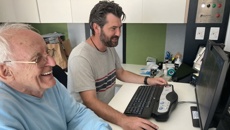

For more than forty years, Richard Faull has been chasing a cure Huntington’s Disease and, as retirement looms, a treatment for the incurable disease is finally within reach.
Distinguished Professor Sir Richard Faull, as he is formally known, is reducing his role at the Centre for Brain Research which he established nearly two decades ago and handing over the role of Director to Professor Hanneke Hulst.
Faull has been honoured by the science community at home and abroad and awarded a knighthood for his leadership of brain research in New Zealand.
He told Newstalk ZB’s Brainstorming podcast the potential Huntington’s breakthrough, if proven effective, will be the best thing to have happened in his lifetime’s work.
Huntington’s disease or HD is an hereditary disease. People with HD have a 50/50 chance of passing the gene on to their children. If those children have the gene, they will develop the disease later in life. Once the disease becomes symptomatic, usually in the person’s 30s or 40s, their physical and mental health deteriorates as they develop an aggressive dementia. Distinguished Professor Sir Richard Faull, as he is formally known, is reducing his role at the Centre for Brain Research which he established nearly two decades ago and handing over the role of Director to Professor Hanneke Hulst.
In the 1980s and 90s, Faull’s study of the brains and profiles of people who died from HD established where mood and movement were located in the brain. It was an international breakthrough and Faull says it changed his life forever.
“I had been studying rat brains but we’re not like rats which just do the same thing over and over again for a thousand years, he told Brainstorming.
“Humans are innovative, we change, we think, we plan, we dream. Looking at the human brains that were donated by the families of those with HD showed every case was different and that’s where collecting family histories showed the link.
“I looked at the pattern of brain degeneration and could compare and correlate it to the mood and motor histories,” he told me.
Trials are underway for two treatments that could significantly slow down the onset and progression of HD. One is an expensive and invasive procedure where a hole is drilled in the
skull and a drug injected into the brain. Faull is more excited by the less dramatic prospect of a one pill a day regime being developed by Skyhawk Therapeutics, a bio-medical company that is conducting Phase 2 and 3 trials worldwide. 1200 people are in the trials, including 120 in New Zealand. Faull says early indications are that the drug is safe to use and might slow down progression of HD by up to 75%.
“I always thought you had to find a cure for everything but if you can keep pushing out a disease, people might never develop it or die of something else in the meantime. I can finally say we have real hope. To be able to go to the HD community with this is a dream come true.”
Brainstorming with Clare de Lore has new episodes every second Wednesday on iHeartRadio or wherever you get your podcasts – powered by Newstalk ZB.
Take your Radio, Podcasts and Music with you
Get the iHeart App

Get more of the radio, music and podcasts you love with the FREE iHeart app. Scan the QR code to download now.

Download from the app stores


Stream unlimited music, thousands of radio stations and podcasts all in one app. iHeart is easy to use and all FREE