

US President Donald Trump’s pick for New Zealand Ambassador says his priority in Wellington will be “expanding our defence partnership”, while he’s made his interest clear in the critical minerals found in the seabed around the Cook Islands.
During a hearing before the US Senate foreign relations committee, Jared Novelly said New Zealand was more aware than most of the “darkening security environment in the Pacific”, which he in part attributed to China.
Novelly, a sports business tycoon known for his ownership of the Australian National Basketball League team the Illawarra Hawks, was first selected by Trump early last year.
But his nomination hadn’t progressed to a confirmation hearing until last Friday.
In his opening remarks, Novelly said he would work “tirelessly to advance President Trump’s and Secretary [Marco] Rubio’s foreign policies”.
“In advancing the President’s agenda, we have few better partners than New Zealand. The Government of New Zealand consistently supports our goals in the region and beyond,” the nominee said.
Alongside being Trump’s man in Wellington, the post comes with representing the US in Samoa, the Cook Islands, and Niue.
Novelly intended to “do everything in my power to take our relationship to new heights”.
He listed three priorities, including partnering with New Zealand to “promote a free and open Pacific”, “expanding our defence partnership with New Zealand” and “promoting opportunities for US business entities”.
“Few countries understand the darkening security environment in the Pacific better than New Zealand,” Novelly said.
“Last February, China conducted live-fire exercises in the Tasman Sea. I was in the region at the time, and it was very concerning. The exercises led to flight diversions and represented an example of alarming, even destabilising behavior in the Pacific.
“If confirmed, I would prioritise expanding our defence partnership with New Zealand.”
Novelly said embassies played a key role in “ensuring a fair playing field for US entities”.
“Whether it be through tearing down trade barriers or opening new markets, all US businesses will have a friend in the ambassador’s office if I am confirmed,” he said.
In terms of his focus on Samoa, Novelly said he would encourage the Pacific Island nation to continue its “prudent approach to managing relations with the West and China, taking on foreign debt with caution”.
He wanted to “ensure it is never pressured into a deal that would compromise its sovereignty”.
With the Cook Islands, of which formal diplomatic relations were established in 2023, Novelly made clear he wanted to “expand our collaboration with local authorities to promote the responsible development of seabed mineral resources”.
“The Cook Islands’ EEZ [Exclusive Economic Zone] contains possibly the largest cobalt deposit in the world – a key component in batteries and high-strength alloys. A strong partnership with the Cook Islands means a strong supply chain of critical minerals. This is good for all parties.”
He would also seek to strengthen the US’ relationship with Niue on “economic, cultural and other programmes”.
Republican Senator Pete Ricketts, chairing the meeting, said New Zealand was a “trusted friend and increasingly important strategic actor in the Indo-Pacific”.
Ricketts noted that New Zealand had taken “meaningful steps to increase defence spending, modernise its military capabilities and engage more deeply in regional security efforts”.
The Government last year announced, through its Defence Capability Plan (DCP), that defence spending would hit more than 2% of gross domestic product (GDP) within the next eight years, with $12 billion planned over the next four.
Last year, the Government said five new Seahawk maritime helicopters – worth more than $2b – would be procured through the United States’ Foreign Military Sales programme.
New Zealand and the United States have long had a close security relationship, including through the Five Eyes intelligence group. However, there has been some criticism that the current Government has cosied up to the US, something Prime Minister Christopher Luxon has denied.
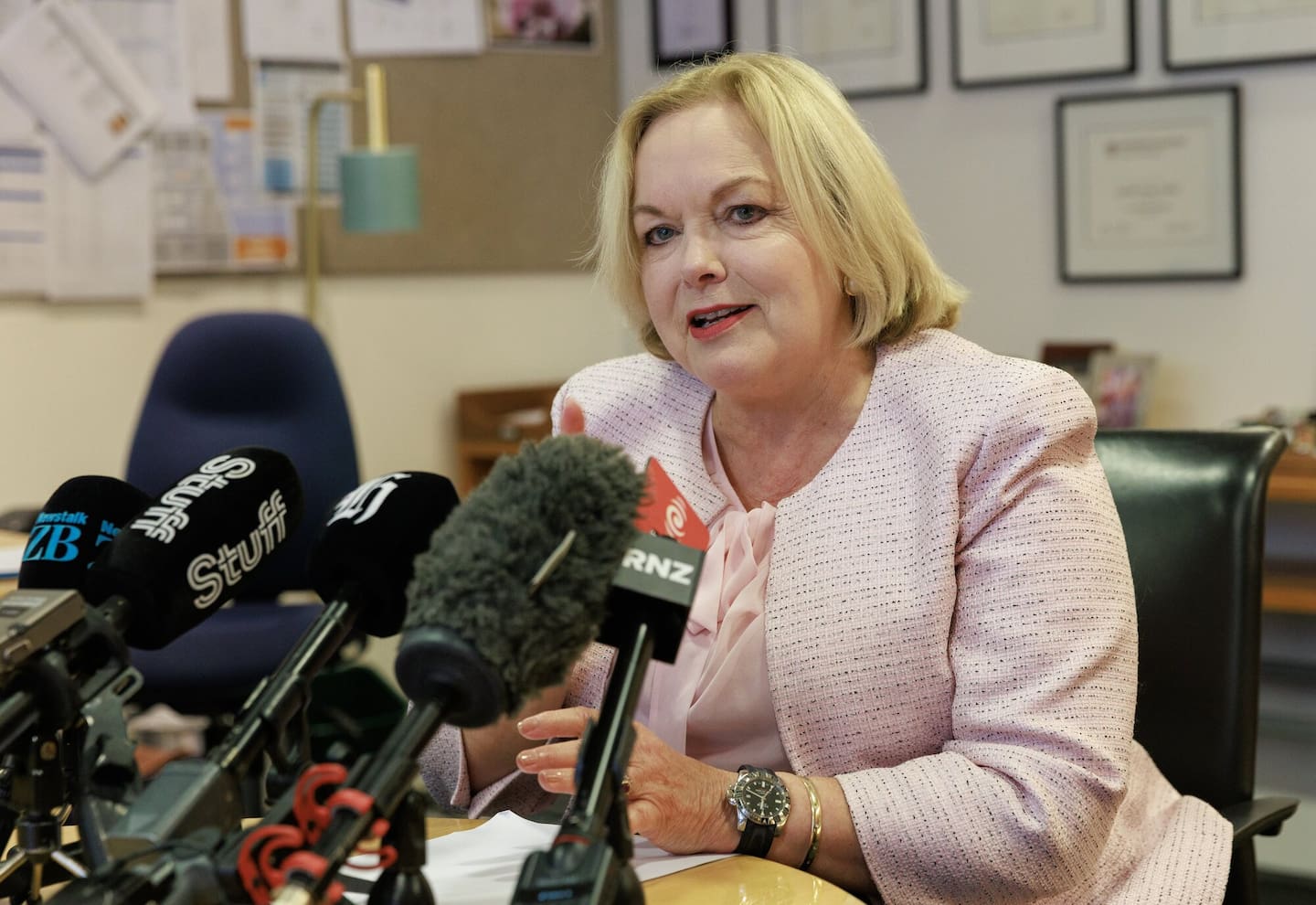
Defence Minister Judith Collins announced a big increase in defence spending last year. Photo / Mark Mitchell
Rickett highlighted China’s growing presence in the Pacific, something New Zealand is aware of. For example, the DCP said there was “strategic competition” between China and the US in the Indo-Pacific.
“China’s assertive pursuit of its strategic objectives is the principal driver for strategic competition in the Indo-Pacific, and it continues to use all of its tools of statecraft in ways that can challenge both international norms of behaviour and the security of other states,” the DCP said.
“Of particular concern is the rapid and non-transparent growth of China’s military capability.”
The Senator called on Novelly to “work to strengthen defence co-operation, expand co-operation in emerging technologies and strengthen supply-chain security”.
Novelly would need to “steer Pacific Island nations away from Beijing’s coercive economic traps”, Ricketts said.
He said that meant being “present” to show the US was “present in the region”.
Democrat Senator Chris Coons asked Novelly about seabed resources around the Cook Islands. The Cooks and the US last month signed an agreement to work together on strengthening supply chains for critical minerals and rare earths.
In his response, Novelly said the Cook Islands’ willingness to exploit its resources was “an extreme opportunity for the US to be able to play its part”.
“I am so impressed by the cultures in the Pacific Islands. Having spent quite a bit of time in the Pacific Islands, the oceans are sacred to Pacific Islanders. The fact the Cook Islands believe they can exploit this in a responsible method, I think is the proper lens to look at it with, as opposed to any lens we might have.”

Prime Minister Christopher Luxon has denied New Zealand is cosying up to the US. Photo / Michael Craig
In February, it was also confirmed that New Zealand was in talks with the United States over a “non-binding” framework relating to critical minerals. Secretary of Foreign Affairs and Trade Bede Corry was in Washington, DC at the time and “committed to explore further opportunities to expand co-operation on critical minerals” with the US.
The final question for Novelly came from Tim Kaine, well-known internationally as Hillary Clinton’s pick for Vice-President during her 2016 run for office.
He asked Novelly to give his assurance that he would keep the US aware of any concerns of the New Zealand Government related to Antarctica. China has been seeking to expand its footprint in Antarctica. Novelly said he would report back on that.
It’s now up to the committee to confirm Novelly. If confirmed, he would likely attend briefings and training, meet relevant US agencies and officials, and then be deployed to his post. Deployment typically occurred within 60 days of confirmation.
Jamie Ensor is the NZ Herald’s Chief Political Reporter, based in the press gallery at Parliament. He was previously a TV reporter and digital producer in the Newshub press gallery office. He was a finalist in 2025 for Political Journalist of the Year at the Voyager Media Awards.
Take your Radio, Podcasts and Music with you
Get the iHeart App

Get more of the radio, music and podcasts you love with the FREE iHeart app. Scan the QR code to download now.

Download from the app stores


Stream unlimited music, thousands of radio stations and podcasts all in one app. iHeart is easy to use and all FREE