

A rare sighting of a young paikea (humpback whale) off the East Coast has excited marine researchers in Tairāwhiti.
Āvei Moana Voyage researchers aboard the SV Resilience spotted the whale while surveying fishing grounds between Whangaokena/East Island and Rāhuimānuka.
The whale, estimated to be about 7 months old, surfaced about 3.5 metres from the boat.
Mere Takoko, co-leader of the Āvei Moana Voyage and chief executive of the Pacific Whale Fund, called the experience a “really magical moment”.
“At 7 months old, this is a very rare sighting because they’re weaning at that age, and so the mother would have been at a depth of 10 to 20 metres - close by somewhere, keeping an eye, but probably resting.”
Takoko said Lee Grace (Ngāti Uepōhatu) was the first to see the humpback.
The vessel was sailing towards Tuparoa, a “well-known” whale corridor.
While June and July sightings were common, it was unusual to spot a whale at this time of year, Takoko said.
The whale surfaced and turned to its side before submerging.
“It was just a really chance sighting, really magical experience to see her in our waters,” Takoko said.
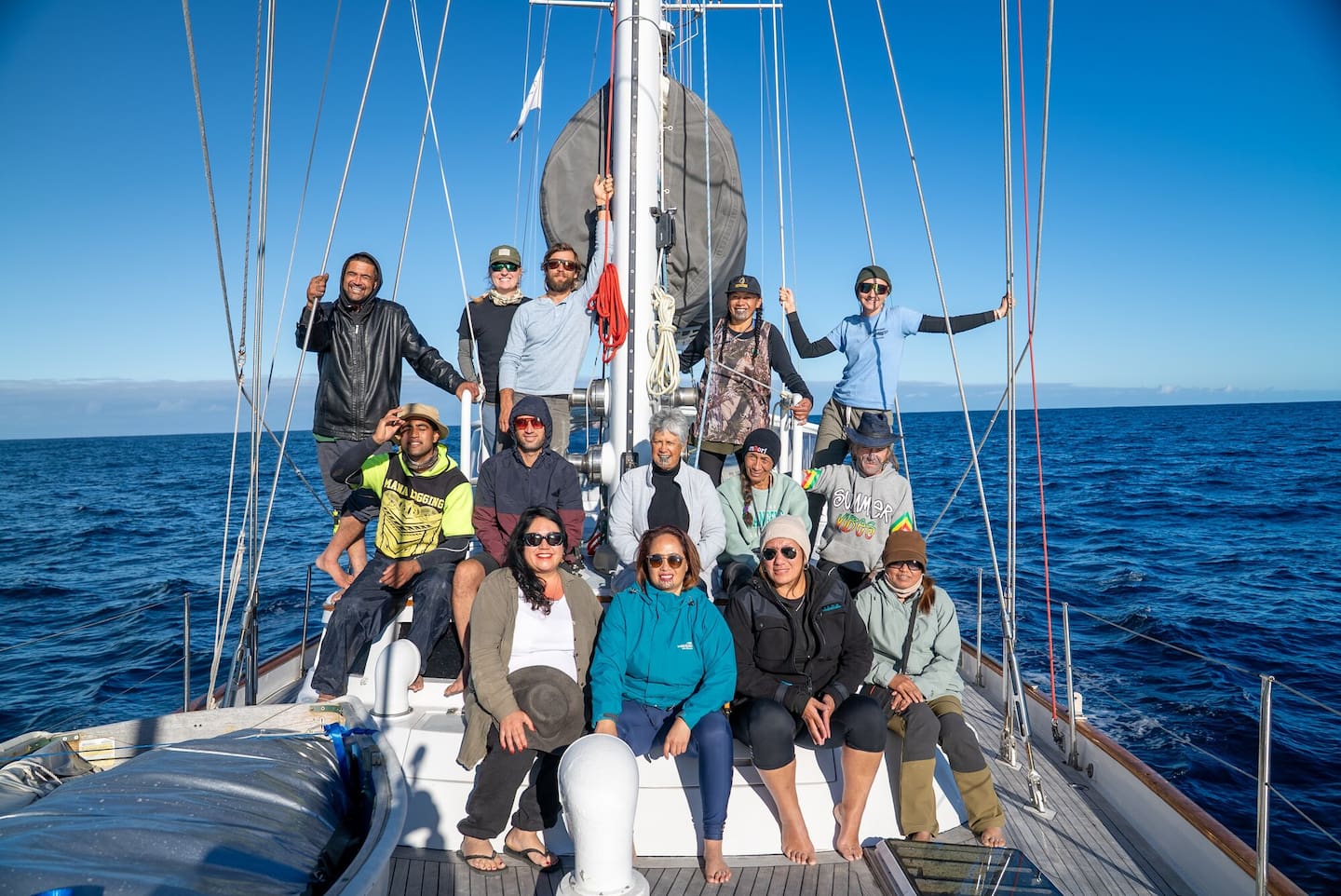
Āvei Moana Voyage researchers were thrilled to spot the young whale. Photo / Moananui Sanctuary Trust
The sighting kicked off the New Zealand leg of the Āvei Moana Voyage, supported by Moananui Sanctuary Trust - an indigenous-led Pacific conservation initiative.
The Āvei Moana ocean science team are spending five days on the East Coast as part of a two-year-long expedition.
Researchers were collecting environmental DNA samples at the time of the whale sighting.
Environmental DNA is genetic material, such as skin cells or faeces, shed by organisms into their environment. It can give researchers an accurate picture of plants, animals, fungi and microscopic single-celled organisms.
The expedition’s ultimate aim is to see a “return and thriving recovery” of paikea, parāoa (sperm whales) and southern right whales in the region, after extreme weather events deposited high levels of silt into waters.
“Understanding these ecosystems is a critical climate resilience solution,” Moananui Sanctuary Trust said in a statement.
“By mapping the biological baselines of these silt-laden environments, the team can better understand how to recover the habitats and food webs that migrating whale populations depend upon.”
Data gathered will support customary marine title applications for 12 Ngāti Porou hapū and “contribute to indigenous-led frameworks for ocean monitoring”.
For Takoko, the whale sighting was extra meaningful.
“(The sighting) was a really special sign of great things to come - that we’re on the right pathway and that the whales know that we’re there for them.”
The voyage is supported by research organisation and non-profit organisation Apparent Winds.
Its boat, the SV Resilience, is a 23m ocean monitoring vessel skippered by Apparent Winds executive officer Prentice “Tripp” Brower.
It has been joined by the vessel Tangaroa on this expedition.
The voyage will continue on to the Marquesas Islands (French Polynesia), Tahiti, Samoa and Tonga.
Take your Radio, Podcasts and Music with you
Get the iHeart App

Get more of the radio, music and podcasts you love with the FREE iHeart app. Scan the QR code to download now.

Download from the app stores


Stream unlimited music, thousands of radio stations and podcasts all in one app. iHeart is easy to use and all FREE


