


Netflix documentary producer Dame Julie Christie was given a heads-up by police that Tom Phillips had been shot, police documents reveal.
The Police Commissioner wanted to terminate a Netflix documentary crew’s inside access to police in the weeks following Tom Phillips’ shooting, new documents reveal.
And he now says the Netflix crew should never have been given access to the shooting scene.
Police Commissioner Richard Chambers told the Herald in a statement today: “It has become apparent this documentary was not always handled in line with the usual protocols and processes that apply to documentaries police take part in.
“I would not have allowed access to what was an active crime scene and had not been aware that was happening ahead of time. Had I known it was to happen, I would have stopped that.”
The Phillips children were found in early September after being missing with their father for four years. The saga ended when Tom Phillips was shot and killed in an early morning shootout with police on September 8.
Almost 300 pages of emails, text messages and other documents have today been released to the Herald under the Official Information Act, highlighting how the documentary came to life, and the producers’ various interactions with police since 2024. Internal police emails have also been released.
“My view is that access should now end given [Operation] Curly is closed,” Commissioner Richard Chambers told several senior staff in an internal email on September 24.
In the days after that, documentary maker Dame Julie Christie wrote to Chambers, encouraging him to consider “a lengthy ‘pause’ over any other action”.
- Tom Phillips inquiry lead being paid a ‘daily fee’ of $1680, documents say including Family Court ‘unwieldy’
- 'Ill-advised': Documentary crew told about Tom Phillips shootout by police before family
- New photos released as Tom Phillips’ ‘primary campsites’ found
- Tom Phillips gag order: Kids' mother joins legal battle
- 'Our sincere apology': Tom Phillips’ parents speak out, say they never supported him
- Injunction continues for key details of Tom Phillips case
- Watch: First look inside Tom Phillips’ 'grim' bush hideout after cordon lifts
- Stuff could face $200k fine over Tom Phillips police audio

One of Tom Phillips' campsites in the Waikato bush.
The documents confirm earlier reports that the Netflix crew was given an early heads-up that Phillips had been shot.
Police director of media and strategic communications Juli Clausen texted Christie at 6.14am on September 8: “I’m on a flight to Hamilton now”.
“I wanted to give u a heads up.. T [redacted] were involved in another burglary this morning. T has been shot - we have [redacted] We will do media but every man n dog there.”
The link to Phillips was not officially announced to the public for several hours.
At 7.04am, police issued a media statement saying they were responding to a serious incident in western Waikato but gave no specific details, saying they would be provided “as they become available”.
At 9am, police reported one man had died, and a police officer had been injured in an overnight incident. Phillips’ link to the incident was officially announced at an 11am press conference.
In the days following, it became clear that Christie’s production crew - later revealed to be working on a documentary destined for Netflix - were being granted special access beyond police cordons.
Police came in for criticism from several quarters, including competing media organisations.
Chambers’ early support
Chambers supported the making of the documentary, having met Christie at police national headquarters in late 2024, and referring it to his media and communications team.
The documents show police started easing back on access in the weeks following Phillips’ death.

Dame Julie Christie is producing a Tom Phillips documentary. Photo / RNZ, Mark Papalii
On September 15 - a week after Phillips was shot - Christie texted Clausen to ask if one of her crew “might be able to join the team looking for the other camp?”
Clausen responded: “I think we need to leave some air space for now. People v sensitive. I’m talking to them tomorrow, hopefully.”
Christie responds: “I respect that, of course. I hope it is realised that all of our shooting shows ... how hard the police team always worked to recover those children. It would be disappointing not to be able to complete that story in the best possible way.”
She said she was “grateful for everything so far” and would keep in touch.
On September 24, Chambers’ chief media and communications advisor Claire Trevett emailed the commissioner, saying executive-level guidance was required “on the appetite for ongoing access to the police operations and staff etc now that Op Curly has wound up”.
She pointed out the Netflix contract specified Op Curly, and not two other corresponding operations: “The documentary will be confined to Operation Curly and the search for the missing Phillips children as agreed with the National Criminal Investigation Group, Police Districts and Media and Communications.”
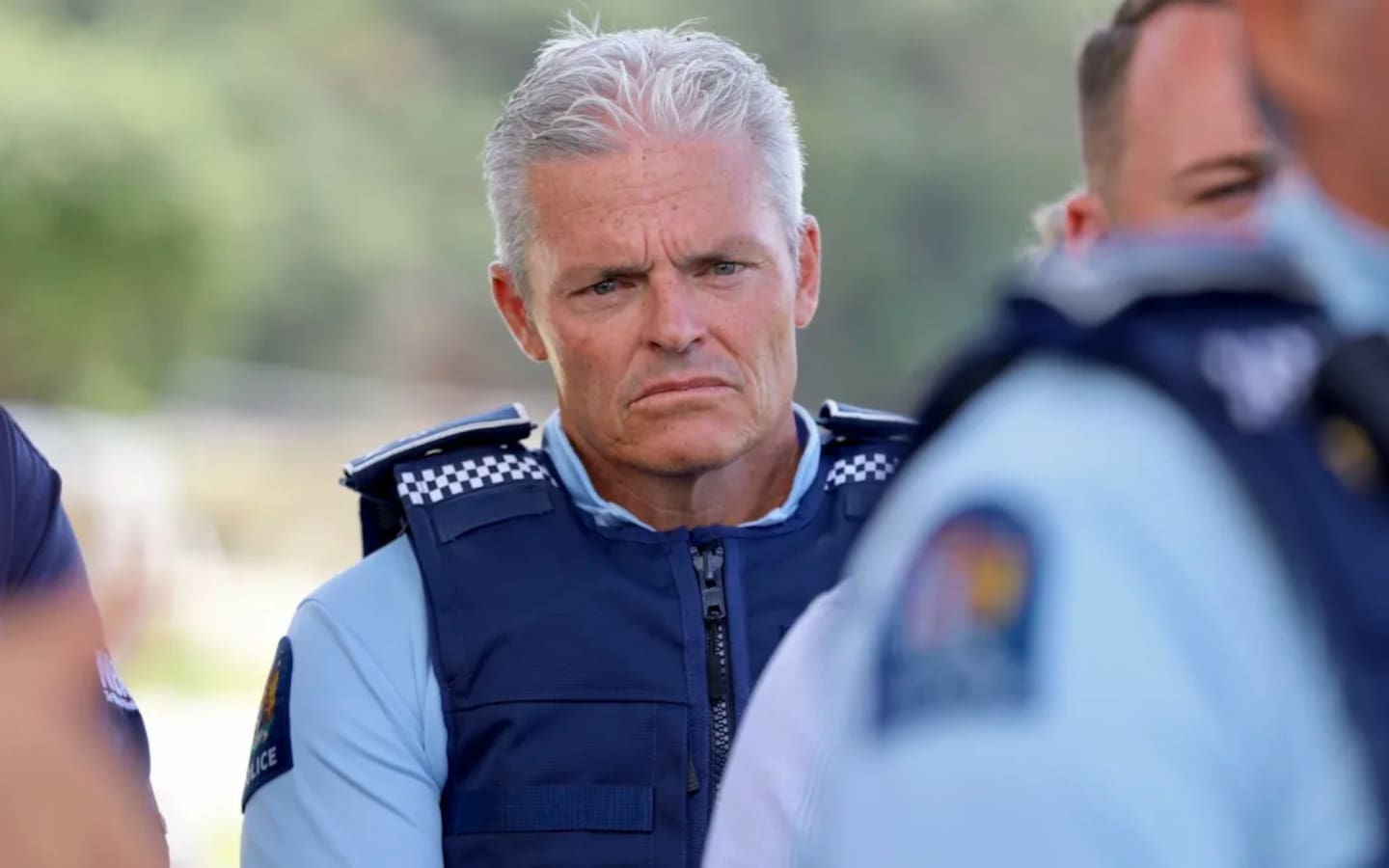
Police Commissioner Richard Chambers. Photo / RNZ, Calvin Samuel
Chambers responds: “My view is that access should now end given Curly is closed.”
On September 26, Christie wrote directly to Chambers seeking a meeting.
“I thought I would let you know now that our partners in the Operation Curly documentary feature, Grain TV and Netflix, have agreed to pause filming until legal matters are dealt with and it is agreeable with the New Zealand police to continue.
“I am hoping that you and your team will also feel that ‘pausing’, for however long, is the best option.
“We began this journey with your staff a year ago, specifically to show that the Operation Curly detectives were doing a lot at a time when they were being heavily criticised by others via daily news media for doing ‘nothing’.
“What we captured over that period shows how much officers like Andy Saunders and Sally Welch really cared. It’s pretty special.
“The scene where you and Mark Mitchell go up to the office and meet them the day after Tom died, and they tell you what they’ve been through, is exceptional.
“The specific focus of the documentary remains to tell the story of the Police who cared deeply about these children. That won’t change over time. We are in for the long haul – which is clear in our contract with you whereby all Courts including Coroners need to be over before we broadcast.
“I hope there will come a time when the story can be told, we don’t know that yet, which is why I am asking you twhich is why I am asking you to consider a lengthy ‘pause’ over any other action.”
The following two paragraphs are then redacted.
Later in the letter she reiterates that she hopes police “will agree to ‘pause’ while the future of the project is considered over time”.
“I am very aware that we are privileged to have been given the access we have.”
Chambers responds on September 28.
“I agree your approach to pause is the right one at this time. And I appreciate your position in respect of the matters to which you refer.”
The documents outline the police PR manoeuvres behind the scenes, and as heat was coming on them over the Netflix documentary crew’s access.
On September 10, Trevett advised Chambers: "There have been several phone calls from media objecting to the lack of access behind the cordon, given the documentary crew’s access - and a formal request from NZME for access behind the cordons (with negotiations over terms and conditions around use of material)."
She said she had spoken to Clausen “about assessing with the investigating team whether it is viable to offer some restricted access in the near future, likely on a pooled basis (one video, one stills photographer), with Police need to approve final footage/ photos prior to use.”
In another internal email, Trevett states, "this doco stuff has blown up a bit".
“I’ve spoken to Julie C and Karen R about police putting out a statement to highlight the specific safeguards that the agreement includes and to clarify that they have not been given any access that involved filming the children etc.”
On September 12, she advises Clausen in terms of media comment on the documentary: “No further comment beyond emphasising there was no access to anything involving the children and police have strong control over the content.
“If we can clarify in more detail what the doco film crew were doing behind the cordons on the day they went it, it might be helpful – as in were they permitted to the campsites still being investigated/ was it just at the sight of the cars/ quad, was it after the investigation into the cars/ quad was completed/ measures to ensure they did not disturb the investigation."
The documentary

The Netflix production crew in Marokopa. Photo / RNZ, Mark Papalii
The documentary – expected to be between 90 minutes and two hours long – is being produced by Christie’s NHNZ Worldwide production company and UK-based Grain Media Ltd. It has the working title The Marokopa Project and is being produced for Netflix.
The documentary is not expected to screen until 2027 at the earliest.
Christie and her production crew received exclusive access behind police cordons as officers investigated Phillips’ four years on the run and the shootout that led to his death.
Her documentary came under media scrutiny earlier in 2025 about whether it should even proceed – and if police should have continued to give exclusive access to producers in light of the shootout.
“I think this documentary needs to be killed off immediately,” Newstalk ZB host Heather du Plessis-Allan said at the time, raising concerns around Phillips’ children.
Christie herself was at the cordoned-off scene of the Phillips confrontation in Waikato, alongside several members of her documentary crew, including at least one camera operator and former TV3 journalist Karen Rutherford.
One journalist told Media Insider at the time that members of the crew had been allowed through the cordon and, for at least two hours, were working at the scene where Phillips shot a police constable at close range, before the father-of-three was shot dead by other officers.
The crew had also been given up-close, exclusive access to senior officers during the day, the journalist said.
In a text message to the Herald in September, Christie said, “I’ve been doing police follow docs for 32 years. We’ve been working on this one all year and through much of the investigation. It’s really important to me.”
Contract reveals police editing powers
Media Insider revealed in December that police have extraordinary powers to preview and demand edits to the documentary if they have concerns, according to the contract earlier released to the NZ Herald.
Police also have the ultimate sign-off on the content.
“The police have the right to preview the documentary before it is screened and the producer shall amend/edit the documentary to accord with any concerns expressed by police regarding issues of security, sensitivity, privacy, any relevant orders of any court and any other matters set out in this agreement,” says the document, titled ‘Operation Curly access agreement’.
The agreement, signed in March last year, specifies that it will not be released prior to the recovery of the Phillips children and the resolution of any applicable court proceedings.
The contract states the documentary is confined to Operation Curly and the search for the Phillips children – the producers will “seek the agreement of individual family members to participate” and “will keep police informed of their arrangements”.
The documentary contract contains standard legal terms and conditions, including ensuring that it complies with any court orders, and has the permission of those being interviewed.
Producers have to abide by police requests, directions and instructions while under operational conditions, and police can terminate access at any time.
But police representatives will also be previewing the documentary, and can make changes.
“The producer will provide an opportunity for nominated representatives of the police to meet with the producers at a time convenient to the police to preview an offline edit of the documentary at a suitable point of production when the treatment, style, and content are clearly apparent, and editing changes to the documentary can still be achieved,” says the contract.
“The police will identify to the producer any concerns they have with the offline edit of The Marokopa Project documentary and subsequent iterations of the documentary at the earliest reasonable opportunity.
“The police will confine any editorial concern it may have to the specific content of The Marokopa Project and to any matters identified in this agreement, including:
“Any material that relates to matters of security; matters which could jeopardise a police investigation, operation, or the safety of any person; matters that affect the ability to subsequently conduct a fair trial; matters which may affect the integrity or legal liability of the police or bring the police into disrepute, including compliance with Family Court orders or any orders of any other court; matters affecting the privacy of any person, including the interests of a deceased person.
“Victim issues where appropriate, including the views of the family, specifically where matters may speak to harm caused to the Phillips children and/or harm caused to members of their wider family, consequent on the documentary being broadcast; youth and family harm issues.”
The contract states that, “in the event of a dispute as to the factual accuracy of the content of the documentary, the decision of the police shall be binding on the producer”.
This is notwithstanding clauses which allow for mediation on any matters.
Dame Julie Christie

TV producer Dame Julie Christie at a police checkpoint in Waikato, near where Tom Phillips died following a police shootout last September. Photo / Michael Craig
Christie is one of New Zealand’s most successful business leaders – a former newspaper sub-editor who later developed her own television company (Touchdown) and took many of her reality TV hits, including Treasure Island, to the world.
There was growing irritation among some media representatives on the ground in Waikato in September, concerned about the access that Christie and her crew were receiving.
“The kind of talk that’s happening between all the reporters is why is this allowed to happen?” said one journalist. “We’re here for the public interest. They’re there to make money. Why would the police be giving them such access? Maybe it’s because the police are able to control the narrative somewhat.”
That comment appears to be borne out by the contract.
It states that the police executive director of communications and the investigation head (or their nominated representatives) have the final approval rights, prior to public release.
“The police viewing committee has the right to require changes to the content of the documentary where editorial concerns are identified, or they consider the provisions of this agreement have been or will be breached,” says the contract.
“The producer will carefully consider all matters identified by the police and shall follow the directions of the police viewing committee to amend the producer’s offline edit.
“For the avoidance of doubt, no additional footage shall be added to The Marokopa Project documentary after agreement has been reached on an offline edit without the prior written consent of the police viewing committee after viewing that additional footage ..."
Editor-at-Large Shayne Currie is one of New Zealand’s most experienced senior journalists and media leaders. He has held executive and senior editorial roles at NZME including Managing Editor, NZ Herald Editor and Herald on Sunday Editor and has a small shareholding in NZME.
Take your Radio, Podcasts and Music with you
Get the iHeart App

Get more of the radio, music and podcasts you love with the FREE iHeart app. Scan the QR code to download now.

Download from the app stores


Stream unlimited music, thousands of radio stations and podcasts all in one app. iHeart is easy to use and all FREE