


A man who drove through a Hamilton intersection, colliding with cars, and killing a pedestrian, has conceded he should have noted he had a medical condition on his driver’s licence applications.
The man, who has interim name suppression, careered through the intersection of Poaka Ave and Whatawhata Rd on the afternoon of April 26, 2021,
In doing so his vehicle T-boned a ute, fatally struck pedestrian Adrian Bell and crashed into two parked vehicles that were then shunted into a house.
The accused, who had a history of suffering seizure-type events, had seen a doctor three days before the incident over concerns he might have had a seizure.
In the dock at Hamilton District Court this morning, the 27-year-old said he couldn’t recall much, if anything, from his previous medical and hospital appointments and had received conflicting advice from family and his wife about what to do, and wasn’t sure if his symptoms were real.
Today, Crown prosecutor Russell Boot and defence counsel Ashleigh Beech also gave their closing statements to Judge Arthur Tompkins, who adjourned the case until Friday afternoon, when he will deliver his reserved decision.
‘They’re like muscle cramps’
In questioning from Beech, the accused said he had experienced “muscle lock-up” around his chest area and feelings of tightness since his late teens.
This also affected his balance and was caused by anxiety and distress.
Talking with his family and GP, he would describe them as “lock-ups”.
“They were like muscle cramps,” he said.
They could get worse and affect his ability to breathe, but he felt able to manage them and had not experienced one while driving before.
Asked if he’d been contacted by the NZ Transport Agency about not driving at any stage before the crash, the defendant said he hadn’t.
“I was led to believe by my neurologist that these [lock-ups] were not real events.
“So I was led to believe I didn’t have any real concerns.”
He didn’t think he had a condition that meant he could lose consciousness.
Three days before the crash, he recalled seeing GP Dr David Dewes as he had “concerns about my condition ... to make sure I was doing the right thing”.
On the day of the crash, he recalled turning left on to Poaka Ave and “felt fine”.
“As I was coming up to the speed bumps, I felt like I had a sudden blackout,” he told the court.
“There were no warning signs ... this had been a new experience for me as with symptoms in the past I had warning signs.”
The next thing he recalled was getting out of his car, collapsing on the ground and seeing members of the public giving Bell first aid.
“I was horrified in that moment as to what happened and I was scared that it was my doing,” he said.
‘He felt he posed no risk on the road’
In her opening statement, Beech said there was no dispute the crash happened, but it didn’t eventuate from dangerous driving.
“[My client] felt that he posed no risk on the road.”
The defendant instead had a condition called somatoform disorder, where an episode looked like an epileptic one but was instead one caused by anxiety or stress.
“They’re not understood to be epileptic seizures or anything that would affect his ability to drive or his day-to-day life,” she said.
Despite seeking medical advice, none of the doctors told her client not to drive, nor did he receive any discharge notes in the mail.
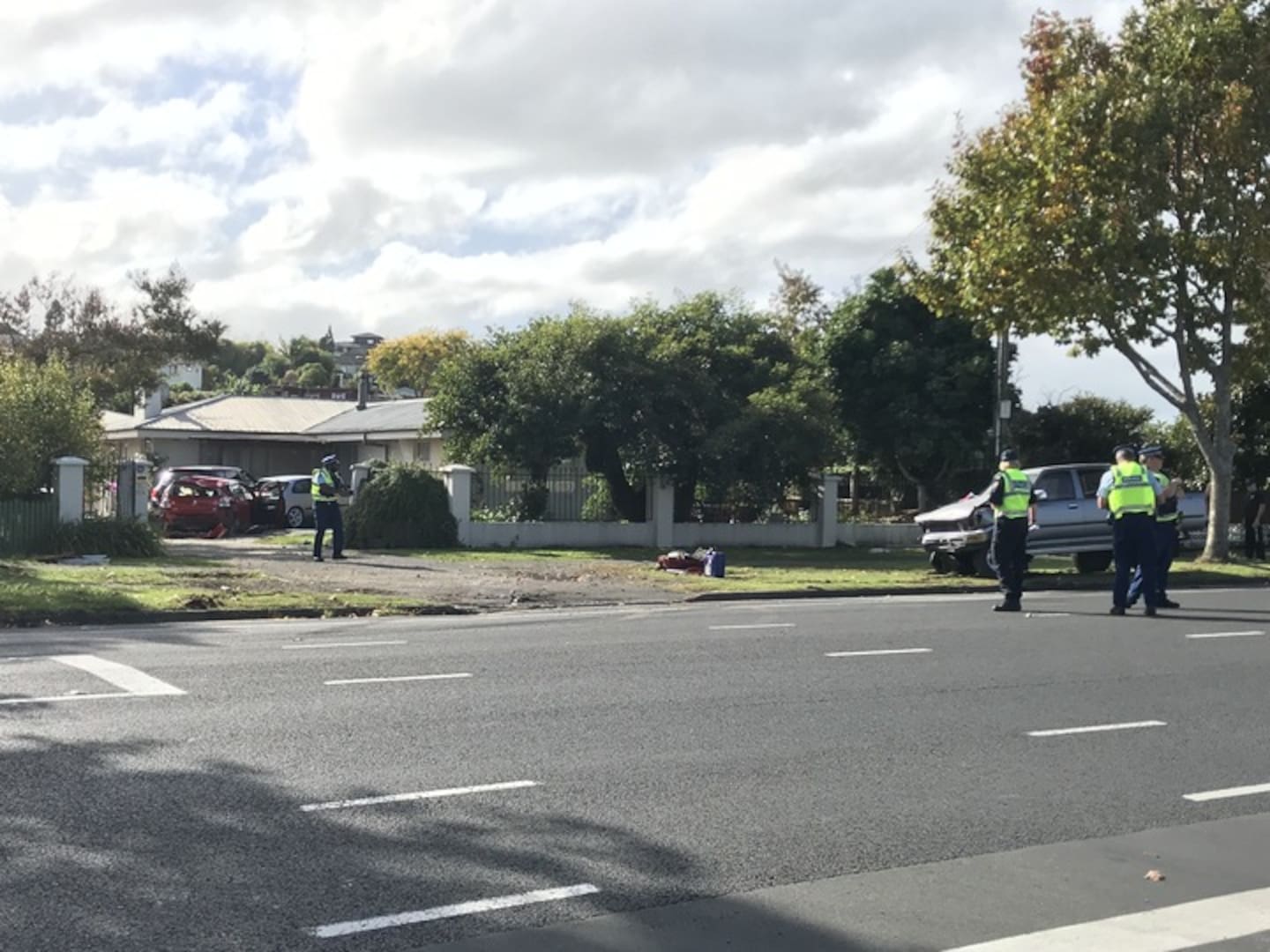
Police at the scene of the crash at the intersection of Whatawhata Rd and Poaka Ave, Hamilton, in April 2021. Photo / Belinda Feek
Although he was unwell, and non-verbal during his December 2020 hospital stay, her client couldn’t recall being told not to drive, “and given his mental state was unable to retain that [information]”.
It was not until shortly after the crash in April 2021 that the accused was diagnosed with epilepsy and soon after had his licence revoked for 12 months.
“On the morning of 26th of April, [he] had slept well, felt well, and had no warning signs before leaving [home] that day.”
It was then, after turning on to Poaka Ave, that he suffered an undiagnosed epileptic seizure for the first time, she said.
She urged the judge to find her client not guilty on both charges, including injury to ute driver Jeffrey Dawson as she categorised his injuries as “trifling”, which didn’t meet the threshold for the offence.
‘Did I kill anybody?’
Boot quizzed the accused about filling out his various driver’s licence applications and ticking “no” to having a medical condition that “could” affect his ability to drive.
“Are you saying to me that you don’t think suffering from ‘lock-ups’ ... had affected your ability to drive?” Boot asked him.
“I considered these lock-ups ... to be similar to a panic attack as they come on due to anxiety or distress and deemed them to be a relatively controlled symptom,” the man replied.

The accused's red Volkswagen after the crash at a Whatawhata Rd property. Photos / Belinda Feek
He said that by deep-breathing, or sitting down, he could regulate them.
Asked whether he was now conceding he should have completed his driver’s licence forms in a different way, given the form states “could” affect his ability to drive, the accused replied, “in hindsight, yes”.
He said that throughout he sought “help from people around me”, including his family and wife.
“And it was still unclear whether the symptoms ... were real.
“So I put ‘no’.”
Boot asked him if he recalled saying, “Did I kill anybody?” after the crash.
“Vaguely,” he said. “I do remember I was yelling in shock.
“I do vaguely remember it more so in the ambulance truck.”
The defendant also admitted getting further medical advice from other GPs about his condition.
Boot put to him that he was trying to go around as many GPs as possible until they told him he could drive.
“No,” the accused replied. “I wanted to make sure that I was being as safe as possible.”
‘He worries about little things’
In her testimony, the man’s now wife said although she and the defendant lived together at the time, she didn’t get on with his family, so was not privy to any of the medical information given to him during his December 2020 appointment.
Asked about her husband seeking medical advice three days before the crash, she said she “didn’t think much of it”.
“Bless him, but he’s very over-cautious and worries about little things.
“He was having trouble breathing but I think it was just asthma.”
Belinda Feek is an Open Justice reporter based in Waikato. She has worked at NZME for 11 years and has been a journalist for 22.

Take your Radio, Podcasts and Music with you
Get the iHeart App

Get more of the radio, music and podcasts you love with the FREE iHeart app. Scan the QR code to download now.

Download from the app stores


Stream unlimited music, thousands of radio stations and podcasts all in one app. iHeart is easy to use and all FREE