
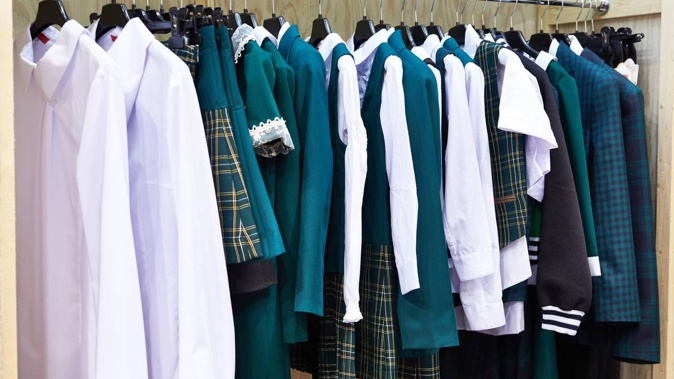
The debate continues over how to tackle the country's cost of school uniforms as schools face the annual complaints over how expensive they've become.
Some uniforms are believed to cost up to $500 and families are skipping meals to afford them.
Kate Gainsford, chairwoman of the Principal's Council told Summer Breakfast this morning a range of expenses contributed to the problem.
"Most schools do factor pricing into their school uniform arrangements but, of course, those costs are also going up, cost of products and such, so I'm imagining this is something that is going to become an increasing issue for people."
Gainsford said when the cost of the uniform is balanced by the practicalities of it being used every day, it can work out to be an okay investment. But the upfront cost sets many families back and is a particular issue, Gainsford said, when families have multiple children attending schools that require uniforms.
On whether schools should consider shifting to normal clothes, like many in the United States, Gainsford said schools could consult with communities.
"Those communities are landing on the side of uniform, but that may change," she said.
"The uniforms themselves change and communities are consulted with this. The expensive items become optional, like the blazers, and woollen jerseys can get swapped out so they're more practical for washing and laundry. It's a moving thing. "
Gainsford was asked if a possible solution was if all schools had the same uniform across the country, with distinguishing features such as ties to set students apart from one another. She agreed the solution would provide some financial benefits.
"That would certainly help some issues around economies of scale - the production side would be much cheaper," she said.
"The schools get themselves locked into a contract with providers sometimes and it can be quite difficult moving out of those. A school can seem big but it's nothing like as big as a whole population of young people."
Many larger countries and big cities follow a single uniform approach, Gainsford claimed, where they make it clear through different shapes and colours of ties and collars to distinguish what school they attend.
Other schools, however, are heavily "wedded" to their uniforms, using them as a marketing tool in a sense that pressures families to keep up with the latest editions.
"So they have the same problem there as they would in a non-uniform school with kind of the tyranny of the brand ruling the day," said Gainsford.
The chairwoman didn't think schools were typically taking a cut from uniform manufacturers, but will do what they can to scale the cost back as much as possible.
"With 2500 of our schools being managed by separate boards, they make up their minds about uniforms so it's up to a community in the end - communities have those votes on their school boards and they do have the power to shift the power to either a city-wide uniform or no uniform at all."
Take your Radio, Podcasts and Music with you
Get the iHeart App

Get more of the radio, music and podcasts you love with the FREE iHeart app. Scan the QR code to download now.

Download from the app stores


Stream unlimited music, thousands of radio stations and podcasts all in one app. iHeart is easy to use and all FREE