

A community microgrid and onsite wastewater treatment plant are some of the key features of an eco-development underway in Northland.
Stage one of the Mangawhai Hills subdivision is progressing, with developer Patrick Fontein hoping the 57 titles will be issued in March.
Eighteen of these titles are already under contract: 10 to local builders to create showhomes and eight to people known to the company, who understand the development’s concept, he said.
A 240sq m “experience centre” has already been built - a large house which is used to demonstrate the design and environmental self-sufficiency of Mangawhai Hills.
It is completely off-grid, running from solar panels and batteries, said development director Tony McKee, who also uses the centre as his office.
Mangawhai Hills is setting up a community microgrid and private power company, including installing cables throughout the subdivision so the solar panels and batteries on each house will connect together, he said.
This integration means excess power can be sold back to the national grid when the price is high, while still having the national grid available as a backup when Mangawhai Hills has high occupancy, McKee said.
“Generating 105% of our annual power consumption is the aim. We would be one of the first developments in the Southern Hemisphere to do it,” he said.
“The excess gets sold back to the grid at the right time, which helps pay for the solar panels.”
McKee said it has taken a year of working with Northpower, advisers Revolve Energy and contractors Omexom to work out the system, which is a first for New Zealand.
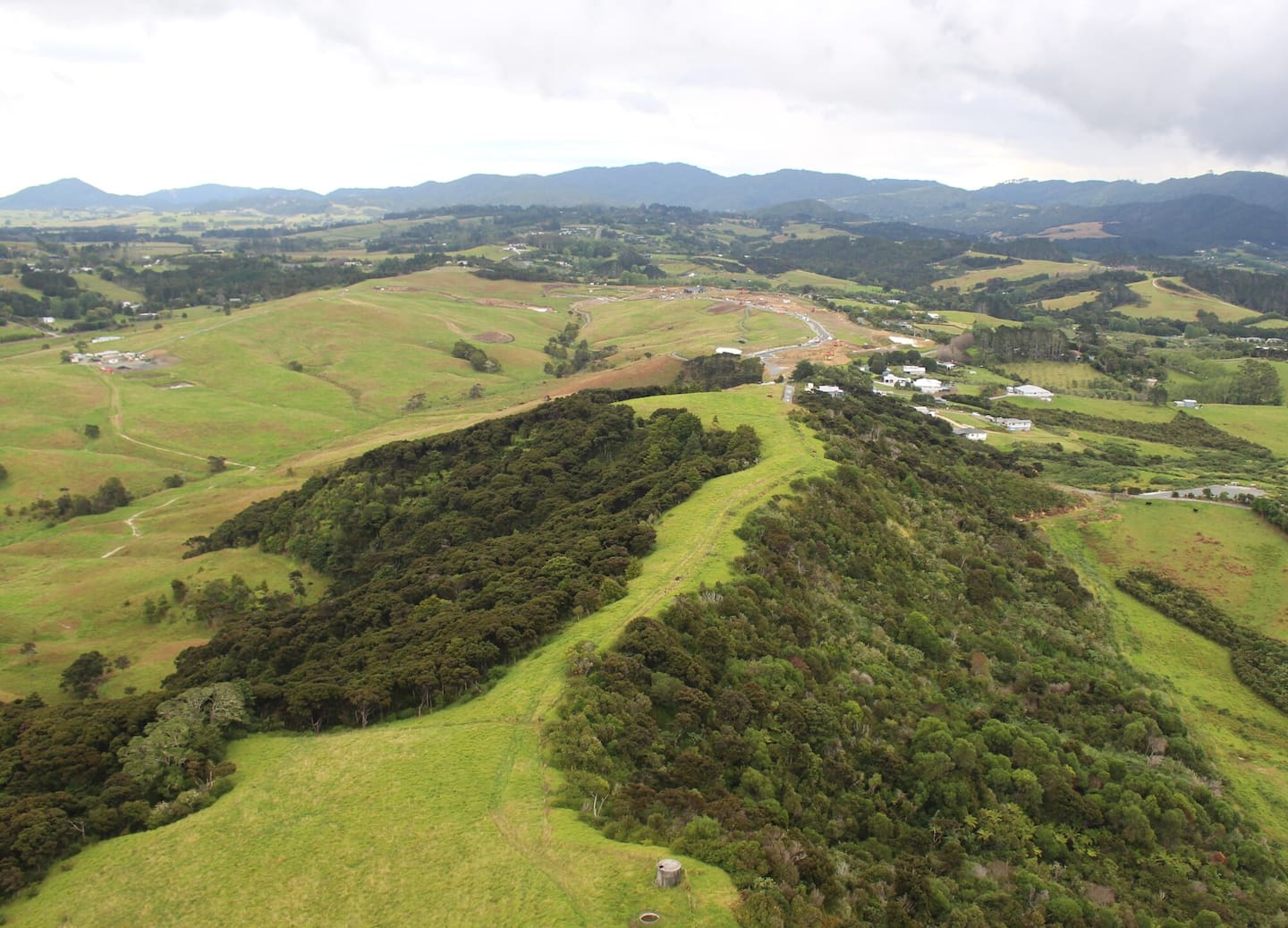
Mangawhai Hills is being developed in several stages but about half the 185ha site is being kept aside for native regeneration. Photo / Denise Piper
Fontein said now the community microgrid has been worked out with Northpower, it can be a demonstration for other developments.
“Solar takes a big commitment financially, but once it’s set up it’s definitely financially viable over six to eight years. It’s what everyone should be doing: the sun is free.”
He hoped the community microgrid will eventually make use of batteries from the likes of old electric cars and generate enough extra electricity to power a supermarket.
Fontein, whose credentials in environmental civil engineering include being former chair of the NZ Green Building Council, believed the development is unique in New Zealand for its self-sufficiency.
This is not only in energy but also drinking water, stormwater, wastewater treatment and carbon.

Stage one of Mangawhai Hills includes stormwater attenuation ponds and a 240sq m experience centre, which will open on Waitangi Weekend. Photo / Denise Piper
“Subdivisions in Australia and the United States use this tech. I look at what works overseas and, if it works, I’m a fast follower which pretty much puts us ahead of what other people in New Zealand are doing,” he said.
“It’s putting it all together in the mix that we’ve got that is new to New Zealand.”
Fontein wanted Mangawhai Hills to help raise the overall standards of subdivisions in New Zealand and said it has already been used as an example for other eco-developments.
“I’d like to show that a more environmental-type design is workable.”
Mangawhai Hills’ titles for stage one are conditional on council sign-off on development milestones, which Fontein said are costing about $2m.

The Mangawhai Hills team includes development director Tony McKee (left), community and stakeholder liaison Steve Brebner and project manager Sam Tietjen. Photo / Denise Piper
Northland Regional Council has been monitoring the site every two weeks for earthworks, siltation control and treated wastewater discharge, while Kaipara District Council will check off the wastewater treatment plant itself and the likes of new roads.
On top of this, the development includes planting some 50,000 native plants, regenerating wetlands and creating 15km of walking and cycling tracks open to the public.
McKee said the response from potential buyers has already been positive.
“Lots of people like the planting, the fact that we deal with wastewater onsite, the regeneration of wetlands plus the trials.
“Our aim is really to make it a community that’s enriching for people.”

The nearby international golf courses of Te Arai, including Tara Iti and Te Arai Links North and South, have helped attract business to Mangawhai. Photo / Denise Piper
Community and stakeholder liaison Steve Brebner said while Mangawhai used to be only baches and holiday homes, the area is growing rapidly with permanent residents and families.
He points to three world-class golf courses in the area - Tara Iti, Te Arai South and Te Arai North - for not only bringing international guests to the area but creating flow-on jobs and businesses.
The 185ha Mangawhai Hills site will eventually be developed into 600 to 750 homes, which will take about 10 years to develop.
Stage one will be marketed to the public starting with an open day on Waitangi Weekend.
Denise Piper is a news reporter for the Northern Advocate, focusing on health and business. She has more than 20 years in journalism and is passionate about covering stories that make a difference.
Take your Radio, Podcasts and Music with you
Get the iHeart App

Get more of the radio, music and podcasts you love with the FREE iHeart app. Scan the QR code to download now.

Download from the app stores


Stream unlimited music, thousands of radio stations and podcasts all in one app. iHeart is easy to use and all FREE


